Choosing a Manufacturing Execution System (MES) is one of the more consequential software decisions a manufacturer will make. It touches production scheduling, quality tracking, machine data, labor reporting, and often becomes the system of record for what actually happened on the shop floor. Get it right and you gain real-time visibility into production. Get it wrong and you end up with a rigid system that nobody trusts, running alongside the spreadsheets and whiteboards it was supposed to replace.
This guide walks through what to look for when comparing MES software, so you can separate the platforms built for your type of manufacturing from the ones that only look good in a demo.
What Is MES Software?
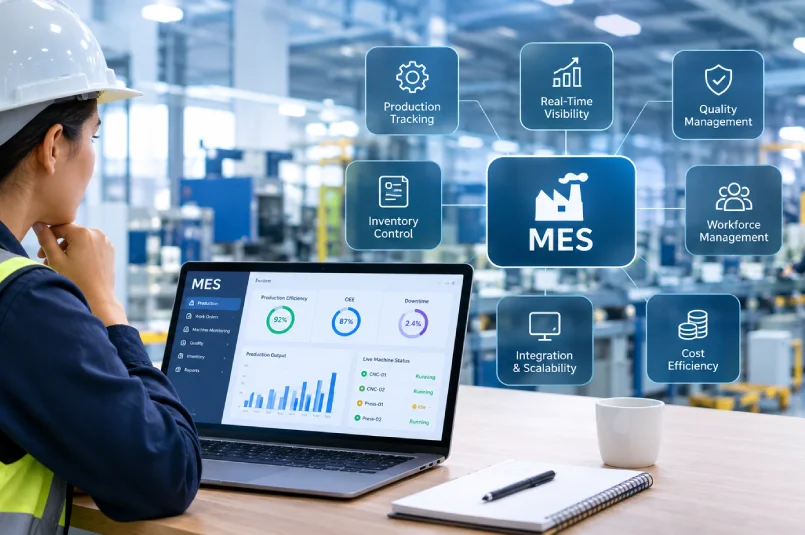
MES software sits between your ERP system and the actual machines and operators on the floor. Where an ERP plans what should happen (orders, materials, schedules), an MES tracks what is happening in real time: machine status, cycle times, downtime reasons, quality checks, and labor activity. It is the layer that turns shop floor data into decisions you can act on the same shift, not the same quarter.
If you are still deciding whether you need MES software at all, or how it differs from adjacent tools, our Machine Monitoring overview and OEE Systems page are good starting points before you get into vendor comparisons.
Core Capabilities to Compare
1. Real-Time Production Visibility
The MES should show you what every line and machine is doing right now, not what a report says happened yesterday. Look for dashboards that update live and that your supervisors will actually check between rounds on the floor, not just during a monthly review meeting.
2. Downtime and OEE Tracking
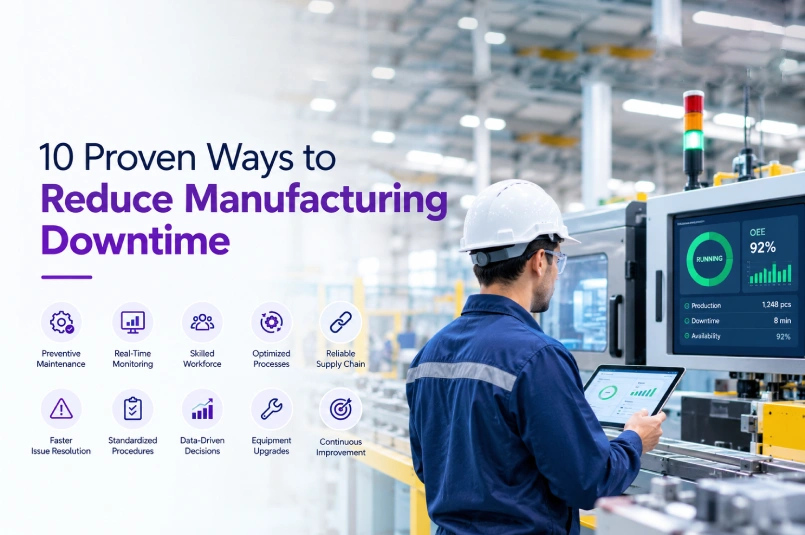
Downtime tracking is only useful if operators can log reasons quickly, without slowing down the line. The best systems make this a two or three tap process on a shop floor terminal, then roll it up automatically into OEE (Overall Equipment Effectiveness) so you can see availability, performance, and quality loss without building a spreadsheet by hand.
3. Andon and Visual Management Integration
Modern MES platforms increasingly connect to Andon systems and Visual Management boards, so a line stoppage or quality alert triggers a visual or audible signal automatically instead of relying on someone noticing and walking over. If your MES cannot talk to your Andon boards, you are maintaining two separate systems instead of one connected one.
4. Ease of Deployment
Some MES platforms require months of configuration and a dedicated integration team before they produce a single useful report. Others are built to get basic tracking running within weeks on your existing machines, with more advanced modules layered in over time. Ask vendors directly how long it takes from contract signature to your first live dashboard, and ask for a reference customer who will tell you honestly.
5. Scalability Across Lines and Facilities
A system that works well for one line in a pilot often behaves differently once it is rolled out across a full facility or multiple plants. Ask how the platform handles multi-site reporting, and whether pricing and complexity scale linearly or become a renegotiation every time you add a line.
6. Reporting That Different Teams Will Actually Use
An MES that only produces reports for plant managers misses most of its value. Operators need simple, real-time views they can glance at without interpretation. Supervisors need shift-level summaries that flag exceptions immediately. Plant managers and executives need trend data across weeks and months to justify capital decisions. When evaluating platforms, ask to see the actual dashboards each role would use day to day, not just the executive summary screen used in the sales demo.
Total Cost of Ownership: Beyond the License Fee
The sticker price of an MES license is rarely the full cost. Implementation services, hardware for machines that lack digital connectivity, training time for operators and supervisors, and ongoing support all factor into what a platform actually costs over its first two to three years. A lower upfront quote paired with a lengthy, consultant-heavy implementation can end up more expensive than a platform with a higher license fee but a faster, more self-serve rollout. Ask every vendor for a full cost breakdown covering the first three years, not just year one.
MES Software vs. ERP: Where the Line Is
This comes up constantly, and it is worth being direct about: an ERP and an MES solve different problems, and one does not replace the other.
|
|
ERP
|
MES
|
|---|---|---|
|
Primary focus
|
Business planning: orders, inventory, finance
|
Shop floor execution: machine status, quality, downtime
|
|
Data timing
|
Historical and planned
|
Real time
|
|
Who uses it daily
|
Planners, finance, procurement
|
Operators, supervisors, quality teams
|
|
Typical update frequency
|
Daily or per transaction
|
Continuous
|
Some ERP vendors will tell you their system already covers shop floor execution. In practice, most ERPs were not built to capture machine-level, real-time data at the granularity an MES provides, which is why so many manufacturers run both side by side, integrated rather than replacing one another.
Questions to Ask Every MES Vendor
- Can it connect to our existing machines and PLCs without a full hardware overhaul?
- How is downtime reason data captured, and how fast can an operator log it?
- Does it integrate with our current ERP, or does data need to be re-entered?
- What does a typical implementation timeline actually look like, with references?
- How is pricing structured as we add lines, users, or facilities?
FAQs
What is the difference between MES and ERP software?
An ERP manages business-level planning like orders, inventory, and finance. An MES tracks real-time execution on the shop floor, including machine status, downtime, and quality data. Most manufacturers run both together rather than choosing one over the other.
How much does MES software typically cost?
Pricing varies widely based on the number of lines, machines, and facilities being monitored, along with which modules (OEE, quality, labor tracking, Andon integration) are included. Most vendors price per line or per facility rather than a single flat fee.
How long does it take to implement an MES system?
Basic production monitoring can often go live within a few weeks on existing machines. Full-featured deployments across multiple lines or facilities, with quality and labor modules included, typically take a few months.
Does MES software require new hardware on the machines?
Not always. Many modern MES platforms can pull data from existing PLCs and controllers, though older or fully manual machines may need lightweight sensors added to capture cycle and downtime data automatically.
Can MES software integrate with Andon and visual management systems?
Yes, and this is one of the more valuable integrations available. Connecting MES data directly to Andon boards and visual management displays means alerts trigger automatically from real machine data, rather than depending on someone manually noticing and reporting an issue.
Ready to see how VersaCall’s platform handles real-time monitoring, downtime tracking, and Andon integration in one system? Schedule a conversation with our team, or browse our case studies to see how manufacturers are using it today.